





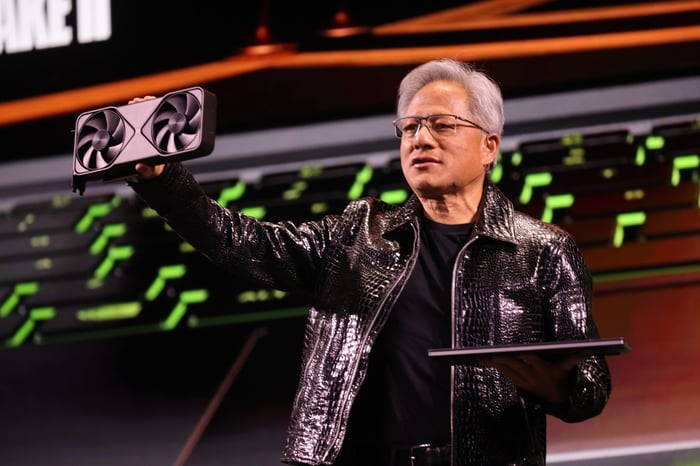
Nvidia CEO Jensen Huang made a striking call to investors during a sharp sell-off in artificial intelligence stocks: instead of fearing the decline, investors should see it as an opportunity to buy at a discount.
Two months later, that argument has begun to look increasingly significant. Nvidia shares have recovered from the downturn and have slightly outperformed the broader U.S. stock market since Huang made his remarks, while a broader basket of major AI-related companies has delivered an even stronger return.
The episode comes after an extraordinary run for Nvidia and other companies at the center of the AI investment boom, followed by growing concerns that valuations had moved too far ahead of business fundamentals.
AI Stocks Came Under Pressure After a Record Run
On May 14, Nvidia shares had climbed above $235, giving the chipmaker a market capitalization of approximately $5.7 trillion.
Investor sentiment subsequently shifted as concerns emerged that enthusiasm surrounding artificial intelligence had moved too far ahead of reality.
Over the following weeks, Nvidia shares dropped around 15%.
Read More

Other major AI-related technology companies were also affected. Alphabet and Amazon each fell approximately 11% during the sell-off.
Jensen Huang Saw the Sell-Off Differently
Huang was in Seoul for a series of business meetings when the market was experiencing the downturn.
His trip included work related to a partnership with South Korean memory-chip manufacturer SK Hynix to design next-generation memory chips for artificial intelligence systems.
Between meetings, Huang spoke with reporters about the state of the AI boom.
Rather than expressing concern about falling technology shares, the Nvidia CEO argued that the artificial intelligence industry was still near the beginning of its expansion.
He said investors should be happy about the market decline because it provided an opportunity to buy shares at a discount.
Nvidia Has Outperformed the S&P 500 Since June 8
The performance since Huang’s comments provides an early test of his argument.
According to the figures cited in the report, Nvidia shares had risen 5.1% since June 8.
Over the same period, the S&P 500 advanced 4.3%.
That means Nvidia outperformed the broader benchmark by approximately 0.8 percentage points during the period.
The difference is relatively small, but investors who followed Huang’s view and bought Nvidia during the downturn would nevertheless have been ahead of the broader market at the time of the report.
A Broader Basket of AI Stocks Performed Even Better
Huang’s remarks can also be interpreted as a broader statement about the artificial intelligence industry rather than Nvidia alone.
The report therefore examined a hypothetical portfolio consisting of equal positions in Nvidia, Alphabet, Amazon and Microsoft.
Performance among the four companies varied considerably.
Microsoft shares had climbed 18.5% since June 8, while Amazon had gained 11.1%.
The report attributed much of those gains to the companies’ recent earnings results.
Alphabet was the weakest performer in the group, falling 0.5% over the same period.
When combined into an equally weighted four-stock AI basket, the hypothetical portfolio generated a return of approximately 8.5%.
That was roughly twice the 4.3% increase recorded by the S&P 500 during the same period.
Huang’s Argument Is About Years, Not Two Months
The short-term recovery is only one part of Huang’s broader view of artificial intelligence.
His argument is not based on the expectation that the AI investment cycle will last only a few months.
Huang has repeatedly positioned artificial intelligence as a long-term transformation of computing infrastructure, with companies spending heavily to build the data centers and computing capacity required to develop and operate increasingly advanced AI systems.
The Nvidia CEO’s outlook therefore extends years into the future rather than focusing solely on the market rebound following the recent sell-off.
From that perspective, the spending currently taking place across the AI industry represents an early stage of a much larger infrastructure investment cycle.
Nvidia Remains at the Center of the AI Infrastructure Boom
The market’s response matters particularly for Nvidia because the company remains one of the most important suppliers of computing hardware used to train and operate artificial intelligence systems.
Its accelerated-computing platforms have become core infrastructure for AI data centers, while demand for increasingly powerful AI systems continues to drive investment in GPUs, networking, memory and other supporting technologies.
Nvidia’s position also means that changes in expectations surrounding AI spending can have an outsized effect on its valuation.
The earlier 15% decline demonstrated how quickly investor sentiment can change even when long-term expectations for artificial intelligence remain strong.