





Apple Maps ads are officially rolling out
Apple has started rolling out advertising inside Apple Maps, turning a plan announced earlier in 2026 into a live feature for iPhone users. Apple confirmed to 9to5Mac that the rollout began in the days leading up to August 25 and will expand to more users over the coming weeks.
The initial launch covers the United States and Canada. Rather than placing conventional banner ads across the map, Apple is inserting promoted business listings into moments when users are already exploring places or actively searching for somewhere to go.
That distinction is central to how Apple is positioning the product. Maps is often used at a point of high intent: someone may be looking for a restaurant, coffee shop, store, repair service or another nearby business and may be only minutes away from deciding where to visit. Apple is giving businesses a paid way to become more visible at precisely that stage of the search process.
Ads can appear in two places
Apple Maps currently provides two main placements for advertisements:
Before a user searches, an ad can appear within Suggested Places on the Maps search screen.
After a user searches, a relevant promoted business can appear in the search results.
Read More

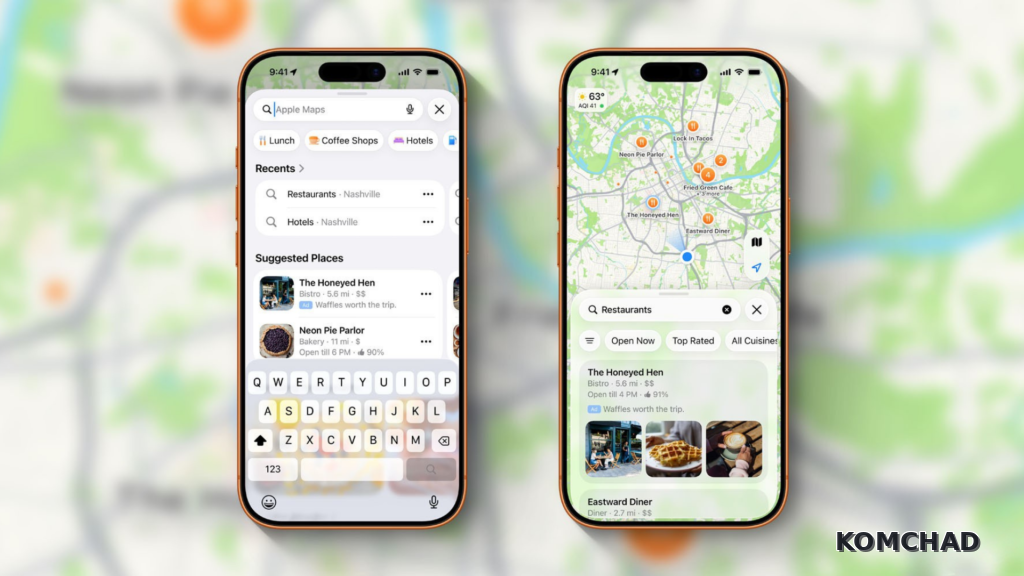
The promoted result is designed to resemble a normal business listing so that it remains integrated with the Maps interface. The important visual difference is a small blue “Ad” badge identifying the placement as paid advertising.
Apple’s own advertising materials describe the first placement as a way for businesses to reach people while they are still exploring. The second targets a later point in the journey, when someone has already entered a search and may be deciding which business to visit.
This gives Apple two different commercial opportunities without filling every part of the map with advertising. One placement can influence discovery before a query is entered, while the other can compete for attention when a user has expressed a more specific intent.
Why Maps is valuable to advertisers
Apple says more than a billion relevant searches for businesses take place in Maps every month, and says one in two searches for a business results in a user taking an action. Those actions can include calling a business, requesting directions or otherwise interacting with its place information.
That makes Maps different from many forms of display advertising. A person searching for a nearby business is already much closer to a real-world decision than someone casually scrolling through a feed. For local businesses, a promoted Maps result can therefore sit directly between discovery and a physical visit.
Apple also says Gen Z and Millennials account for 57% of Maps users. The company is using that audience profile, combined with search intent, to pitch Maps as a direct channel for businesses that want to turn digital visibility into calls, navigation requests and foot traffic.
Advertisers can claim their business location, upload photos, choose a budget and start or stop campaigns. Apple is also promoting more advanced campaign-management options through the broader Apple Ads platform.
Apple is emphasizing privacy as ads arrive
The arrival of ads creates an obvious tension for a product that Apple has long promoted around privacy. Apple is addressing that concern by arguing that Maps advertising follows the same privacy-first approach used across the service.
According to Apple, a user’s location and the ads they view or interact with are not associated with their Apple Account. Personal data remains on the device, is not collected or stored by Apple Ads for this purpose and is not shared with third parties.
Apple says it does not use a person’s precise location or their history of Maps interactions to decide which local ads to show. Instead, ad relevance can use contextual signals such as the current search term, an approximate device location or the portion of the map currently visible on screen.
Precise location is not used for Maps ad targeting.
Maps interaction history is not used to build the ad context described by Apple.
Age and gender are not used to target Maps ads.
Ad views and taps are associated with a random identifier that rotates multiple times per hour.
Apple says personal ad data is not linked to the user’s Apple Account.
For accounts registered to children under 13 and educational Managed Apple Accounts, Apple says on-device logic prevents Maps ads from being displayed.
The ads are meant to feel like part of Maps
Apple’s implementation is deliberately restrained compared with ad formats that interrupt content. Promoted businesses appear as place results rather than pop-ups or large banners. That means the ad can still provide the same practical actions users expect from a Maps listing, such as calling a business or getting directions.
The design also makes disclosure important. Because a promoted result can visually resemble an ordinary listing, the blue “Ad” label is the key signal showing that the business paid for placement.
For users, the biggest change is therefore not a new section of the app but a change in how some recommendations and search rankings can appear. A business shown prominently may now be there because it purchased an ad, provided that the placement is relevant to the user’s search or current Maps context.
Apple is giving businesses incentives to start advertising
Apple has opened the Maps advertising system to businesses and is using promotional credits to encourage early adoption. Its current Grand Opening Promo offers eligible advertisers a credit equal to 15% of monthly Maps ad spending for up to one year, subject to monthly limits and the program’s eligibility rules.
Apple also offers a one-time sign-up credit to eligible new brands that establish an Apple Business organization, add a valid payment method and begin running a Maps campaign.
These incentives show that Apple is not treating Maps ads as a small experiment hidden inside the app. The company is building a complete advertising product around the feature, including business onboarding, budgets, campaign controls, reporting and tools for agencies.
For Apple, Maps advertising creates another services revenue opportunity. For local businesses, it creates a new paid route to visibility at the moment an iPhone user is deciding where to go. The long-term question will be whether Apple can expand that commercial layer without making Maps feel meaningfully more cluttered or less trustworthy to the people who use it for navigation and local discovery.