




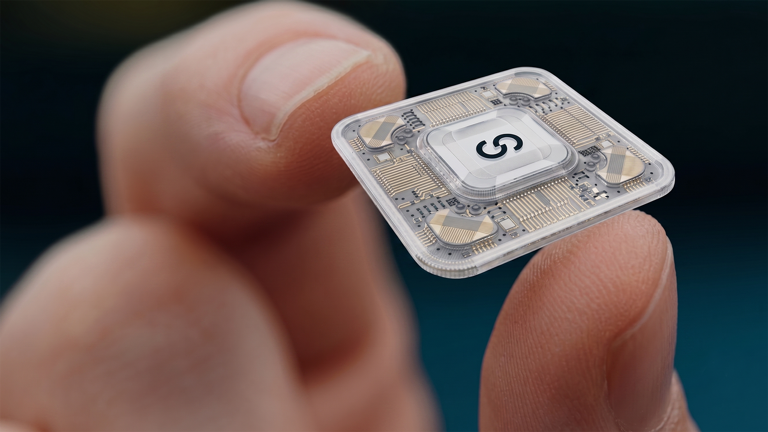
A German quantum computing startup has introduced a new generation of diamond-based quantum systems designed to operate at room temperature, potentially removing one of the biggest infrastructure barriers associated with today’s quantum computers.
Saxon Q’s technology uses nitrogen-vacancy, or NV, centers created inside synthetic diamonds as quantum bits. Live Science reported that the company’s system is the first diamond-based NV quantum computing platform of its kind to move beyond the 10-qubit threshold.
Unlike superconducting quantum computers that depend on extremely low operating temperatures and complex cryogenic equipment, Saxon Q’s systems are designed to operate in ordinary environments. The company says they can fit into standard server infrastructure and draw power from a conventional electrical outlet.
Diamond Defects Become Quantum Bits
NV centers are microscopic imperfections in a diamond’s crystal lattice. They are formed when a nitrogen atom occupies a position normally held by carbon while an adjacent lattice position remains vacant.
These defects can exhibit quantum properties that allow them to function as qubits.
One important advantage of the technology is that NV centers can retain useful quantum properties at room temperature. This gives diamond-based systems a fundamentally different infrastructure profile from platforms that require temperatures close to absolute zero.
Read More

Saxon Q Pushes Beyond the 10-Qubit Barrier
Creating large numbers of usable NV centers has historically been difficult, making it challenging to scale diamond quantum computers beyond relatively small qubit counts.
Saxon Q says its engineering and fabrication techniques have allowed it to move beyond that limitation.
The company’s current rack-mounted offering reaches up to 128 qubits. Saxon Q identifies the commercial system as the SXQ128 and says it is orderable with an approximately three-month delivery period.
The larger SXQ512 is planned for availability from the second quarter of 2027.
No Cryogenic Refrigerator Required
One of the most significant differences is operating temperature.
Saxon Q specifies an operating range of approximately 18 to 27 degrees Celsius, or around room temperature. Its technology therefore does not require dilution refrigerators or other cryogenic systems normally associated with some leading quantum architectures.
The company lists standard 230-volt power as sufficient for its systems.
That could make quantum hardware easier to integrate into conventional data centers and, eventually, computing environments outside specialized laboratories.
From Server Racks to Edge Computing
Saxon Q sees compact quantum processors as more than data-center machines.
Its roadmap describes potential deployment in robotics, automobiles, aerospace systems and edge AI, where processing close to the source of data could avoid the latency involved in sending workloads to a remote quantum computer.
The company envisions quantum acceleration being installed alongside conventional computing hardware rather than being isolated inside a dedicated cryogenic facility.
10,000-Plus Qubits Are on the Roadmap
Saxon Q’s current roadmap extends well beyond the 128- and 512-qubit systems.
For the period after 2030, the company is targeting a single embeddable quantum chip containing more than 10,000 qubits.
Moving from today’s systems to that level would require major advances in manufacturing, qubit control, connectivity and reliability.
Independent Validation Remains Important
The qubit count alone does not determine how useful a quantum computer is.
Quantum systems must also be evaluated according to factors such as fidelity, error rates, coherence, connectivity and their ability to execute useful algorithms.
Live Science noted that while it reviewed a technical white paper describing Saxon Q’s technology, it was still unclear exactly how the company’s machines compare with competing quantum platforms.
That distinction is important as Saxon Q moves from demonstrations and early deployments toward commercial systems containing hundreds and eventually thousands of physical qubits.