




A quantum entanglement theory proposed more than two decades ago has finally been demonstrated experimentally, offering a new approach to creating stable connections between distant quantum bits without relying on continuous active control and measurement.
- Why Quantum Entanglement Matters
- Traditional Methods Require Active Control
- A “Quantum Bath” Connects Distant Qubits
- Experiment Used Qubits Separated by 50 Centimeters
- Stable Entanglement Could Remain Available on Demand
- Researchers Verified the Qubits Were Entangled
- Potential for Hybrid Quantum Systems
- Current Efficiency Is About 10%
- A Path Toward Larger Quantum Networks
Physicists at the Institute of Science and Technology Austria (ISTA), working with researchers from the Technical University of Munich in Germany, demonstrated a fully autonomous method for distributed quantum entanglement using what the researchers describe as a “quantum bath” of correlated light particles.
The experiment provides a proof-of-concept for an idea that could become important as quantum computers move toward larger, modular architectures. Future quantum processors are expected to require reliable entanglement between physically separated modules, making the ability to stabilize distant qubits a significant engineering challenge.
The research was published in Physical Review X under the title “Distributing stationary qubit entanglement through a non-local squeezed reservoir.”
Why Quantum Entanglement Matters
Quantum entanglement describes a phenomenon in which the properties of quantum particles become correlated in ways that cannot be explained by classical physics.
Albert Einstein famously referred to the phenomenon as “spooky action at a distance.”
Read More

Qubits, or quantum bits, are the fundamental information units used by quantum computers. Unlike conventional bits, which represent either 0 or 1, qubits can exist in quantum superpositions involving both states.
Entanglement allows multiple qubits to share quantum correlations, making it a fundamental resource for quantum computing, quantum communication and other emerging quantum technologies.
Maintaining useful entanglement, however, remains difficult because quantum systems are extremely sensitive to environmental disturbances.
Traditional Methods Require Active Control
Existing approaches to distributed entanglement commonly require active operations.
One method involves sending a single actively controlled photon between two qubits.
Another approach has each qubit emit a photon before the photons are matched through a measurement process.
These methods can create entanglement, but they require repeated control and measurement and do not always succeed.
The researchers wanted to develop a system capable of maintaining useful entanglement autonomously.
A “Quantum Bath” Connects Distant Qubits
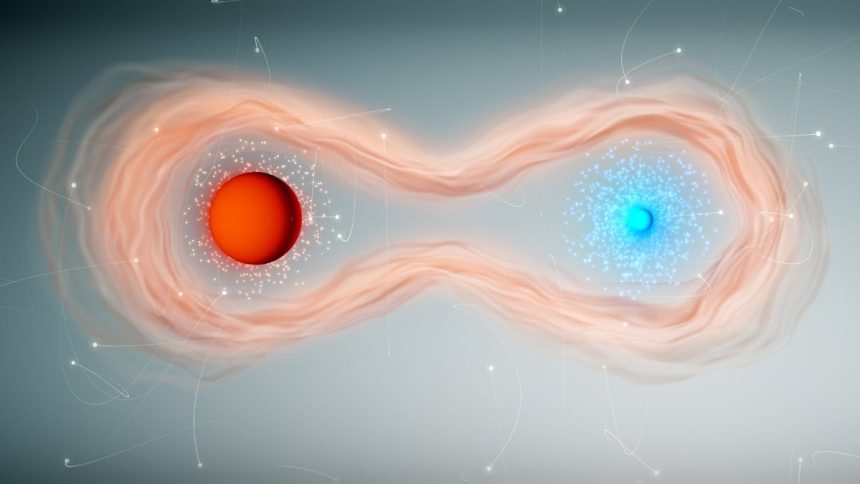
The new experiment uses a reservoir, or “quantum bath,” consisting of correlated microwave photons.
Instead of repeatedly manipulating the individual qubits, researchers expose both qubits to low-energy correlated microwave radiation.
Interaction with this engineered environment drives the two separated qubits toward an entangled state and continuously stabilizes that state.
Alejandro Andrés-Juanes, an ISTA physicist and first author of the study, explained that the researchers wanted to overcome the difference between forms of entanglement that can be readily generated and those that are practically useful.
By remotely stabilizing the entangled states, the system can operate autonomously without requiring active control or measurement.
Experiment Used Qubits Separated by 50 Centimeters
In the proof-of-concept experiment, the qubits were separated from the source through approximately 50 centimeters, or 20 inches, of cable.
The underlying scheme, however, is not fundamentally restricted to that distance.
The researchers say the approach could theoretically operate across arbitrary distances, an important property for future distributed quantum systems.
A single source of correlated photons could also potentially be used to generate multiple entangled pairs.
That capability could become valuable when quantum processors need to connect increasing numbers of separate computing modules.
Stable Entanglement Could Remain Available on Demand
One of the important features of the experiment is the ability to create stationary entanglement.
Instead of producing an entangled state that appears temporarily and must immediately be used, the engineered quantum environment continually pushes the qubits back toward the desired state.
Johannes Fink, an ISTA physicist and senior author of the study, said the entangled qubit state can remain stabilized even beyond the qubits’ own lifetime and remain available as a resource for subsequent quantum processing.
This ability could make entanglement more practical as a persistent computational resource.
Researchers Verified the Qubits Were Entangled
The researchers also needed to confirm that the two qubits were actually sharing the intended quantum state.
They used extremely short microwave pulses lasting only billionths of a second to measure the qubits.
Quantum measurement presents a fundamental challenge because observing a qubit causes its superposition to collapse into a definite state.
This issue is closely connected with decoherence, one of the central obstacles facing quantum computing.
When qubits lose their quantum behavior, they also lose the computational properties that make quantum processors potentially useful.
Potential for Hybrid Quantum Systems
The technique could also have implications beyond systems containing identical qubits.
The researchers suggest that photons operating at different frequencies, including optical and microwave frequencies, could potentially stabilize entanglement between qubits operating at very different energy scales.
Such a capability could support hybrid quantum systems combining different types of quantum hardware.
That could become increasingly important as researchers explore modular architectures that connect specialized quantum components rather than building every function into a single processor.
Current Efficiency Is About 10%
The experiment remains a proof of concept and currently has important limitations.
According to Andrés-Juanes, the method transfers about 10% of the entanglement available in the quantum bath.
Existing approaches based on active control of qubit states therefore remain more efficient.
However, the researchers view the method as a scalable framework rather than a finished technology.
The system could potentially be improved to distribute entanglement more efficiently and connect larger numbers of distant qubits.
A Path Toward Larger Quantum Networks
The significance of the experiment lies partly in its scalability.
A future quantum computer may not consist of one enormous processor. Instead, multiple smaller quantum modules could be connected together to operate as a larger system.
Distributed entanglement would be essential for such architectures because separate modules need quantum correlations to exchange and process quantum information.
The researchers say their relatively simple method could ultimately be scaled to synchronize multiple distant qubits, potentially providing another building block for larger quantum processors and quantum networks.