




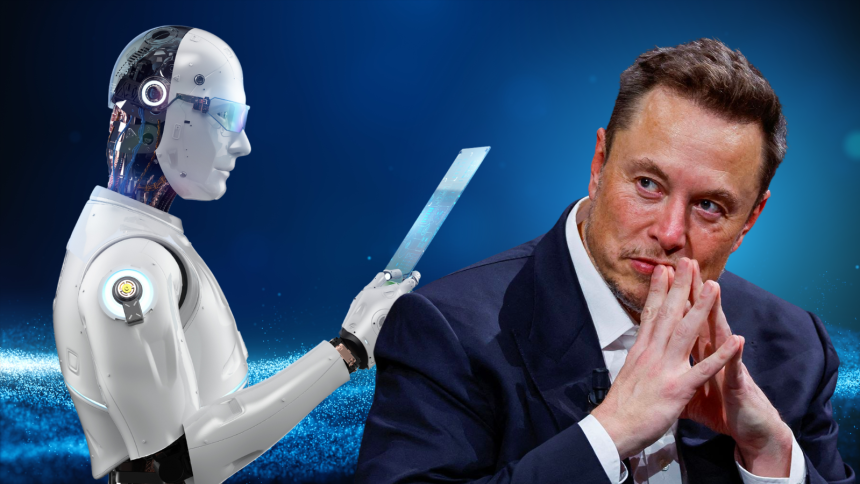
Artificial intelligence has generated increasingly ambitious predictions about the future, but Elon Musk is now suggesting that humanity could eventually lose its position as the dominant intelligence controlling the technology it created.
Speaking in an interview with The Economist in July, the Tesla and SpaceX CEO said he believes artificial intelligence could exceed the combined intelligence of humanity within roughly five years.
“I think AI may exceed the sum of human intelligence in around five years,” Musk said.
He added that there may eventually be almost nothing AI cannot perform better than humans, apart from simply being human.
Musk Says Humans May Not Remain in Control
The Economist Editor-in-Chief Zanny Minton Beddoes asked Musk whether his prediction meant humans would no longer be in control within 10 years.
“I think it is unlikely,” Musk replied.
Read More

Musk illustrated his argument by comparing the potential intelligence gap between humans and advanced AI with the difference between humans and chimpanzees.
He argued that if the intelligence difference between AI and humans eventually becomes vastly greater than the intelligence difference between humans and chimpanzees, it becomes difficult to imagine humans remaining in charge.
Musk described humans as essentially an evolved form of chimpanzees and noted that, on an evolutionary timescale, it was not particularly long ago that human ancestors were living in trees.
The comparison illustrates Musk’s broader argument: if AI eventually becomes vastly more intelligent than humanity, humans may have no more ability to control it than less intelligent species have to control humans.
Musk’s Position on AI Has Changed
The comments are notable because Musk has spent years publicly warning about the potential dangers associated with increasingly capable artificial intelligence.
His position, however, appears to have shifted from attempting to slow AI development toward accepting that the technological momentum may now be impossible to stop.
“I can’t see any way to really stop this incredible momentum of AI and robots,” Musk said.
He added that even if humanity had a hypothetical button capable of stopping the development, it might not be desirable to press it because he believes the most likely outcome is extraordinary abundance for humanity.
Musk summarized his current attitude toward the rapid development of artificial intelligence with the remark: “Let’s enjoy the ride.”
From AI Risk Warnings to Acceptance
Musk’s current comments contrast with warnings he has issued over the previous decade.
In earlier discussions, Musk repeatedly raised concerns about rapid recursive self-improvement in artificial intelligence and the possibility that increasingly capable AI systems could eventually become difficult for humans to control.
He was also among the signatories of a 2023 open letter calling for a temporary pause in the development of the most powerful AI systems.
During the Economist interview, Musk noted that he was one of roughly 500 people who signed the initiative.
His concerns about AI risks have not completely disappeared. Musk said he still believes risks associated with AI and robots exist and are not zero.
What has changed is his philosophical response to those risks.
Rather than believing the technological trend can realistically be stopped, Musk now appears more inclined to accept continued acceleration while focusing on the potentially positive outcome.
OpenAI and Google’s Early AI Competition
Musk also reflected on his own involvement in the development of the modern AI industry.
He said OpenAI was originally established as a counterweight to Google’s early position in artificial intelligence.
Musk was one of OpenAI’s co-founders when the organization was launched in 2015.
According to Musk, however, the competitive response produced unintended consequences by accelerating AI development.
“These actions have actually resulted in knock-on effects that accelerated AI, which wasn’t really my intention,” Musk said.
“It just seems like all roads lead to acceleration of AI.”
AI Could Surpass Collective Human Intelligence
Musk’s prediction goes beyond the idea that AI will outperform individual humans at specific tasks.
His statement suggests that AI systems could exceed the combined intelligence of humanity within approximately five years.
Modern AI systems already outperform humans in some narrowly defined computational and analytical tasks, while generative AI models are increasingly capable of writing software, analyzing information, generating images and video, conducting research, and operating digital tools.
The much larger question is whether those capabilities will develop into systems that outperform humans across most economically and intellectually important activities.
Musk believes that threshold could arrive far sooner than many people expect.
The Question of Who Controls Advanced AI
If AI becomes substantially more intelligent than humans, the issue of control becomes increasingly important.
Today’s AI systems remain dependent on human-designed computing infrastructure, software, energy supplies, data centers and operational rules.
Future systems with significantly greater autonomy could change that relationship, particularly if AI becomes capable of improving software, operating robots, conducting research and managing complex systems with limited human intervention.
Musk’s chimpanzee comparison is intended to illustrate the scale of the potential intelligence imbalance rather than provide a technical prediction of how control would actually transfer.
The underlying issue is whether humans can reliably supervise systems whose reasoning and capabilities may eventually exceed their own.
AI Development Continues to Accelerate
The global technology industry is currently investing enormous resources into artificial intelligence infrastructure, models, robotics and data centers.
Major technology companies are competing to develop increasingly capable AI systems while integrating them into search engines, productivity software, smartphones, cloud platforms and physical robots.
Musk is also directly participating in that competition through his AI company xAI while Tesla continues developing autonomous driving technology and humanoid robots.
His latest remarks therefore reflect both his long-running concerns about advanced artificial intelligence and his position as one of the executives actively investing in its continued development.