





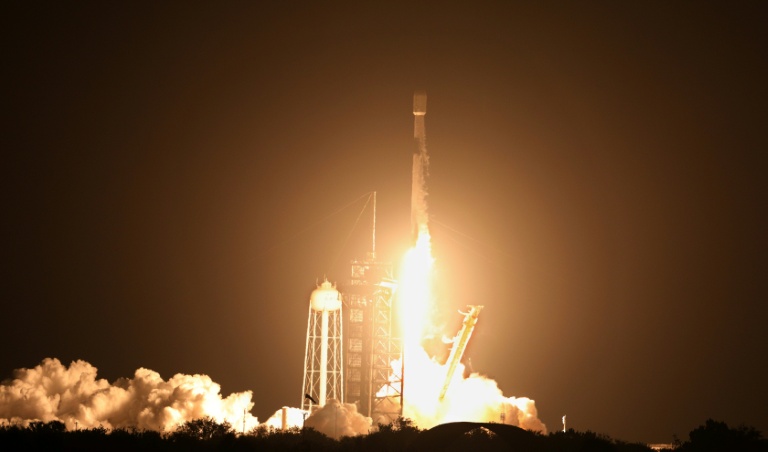
SpaceX Rocket Stage Confirmed to Have Crashed Into the Moon
A discarded SpaceX Falcon 9 upper stage has officially impacted the Moon, creating one of the few confirmed human-made collision sites on the lunar surface. The event offers scientists an uncommon chance to observe how artificial objects strike another celestial body while drawing renewed attention to the long-term management of space debris beyond Earth’s orbit.
Astronomers had predicted the impact months in advance. Their calculations were confirmed after telescopes detected a plume of debris erupting from the Moon at the expected location and time, providing strong evidence that the rocket stage had reached the lunar surface.
The upper stage originated from a January 2025 SpaceX mission that launched Firefly Aerospace’s Blue Ghost lunar lander together with ispace’s Resilience lander. After completing its primary mission, the rocket stage remained in an unstable orbit between Earth and the Moon before gravitational forces gradually altered its trajectory, sending it on a collision course with the lunar surface.
Researchers estimate that the approximately 4-ton rocket stage struck the Moon at around 5,400 mph (8,700 km/h) near Einstein Crater, close to the boundary separating the Moon’s near side from its far side. Unlike objects re-entering Earth’s atmosphere, the rocket did not burn up because the Moon lacks a substantial atmosphere, allowing it to hit the surface intact.
Debris Plume Confirms the Collision
Read More

Although no observatory captured the exact moment of impact, astronomers quickly gathered compelling evidence afterward.
A telescope in Chile detected a cloud containing sodium and lithium, elements consistent with both lunar material and components of the rocket stage. Scientists believe the sodium was released from lunar soil blasted into space by the impact, while the lithium most likely originated from the spacecraft itself.
The plume remained visible for several minutes before dispersing, giving researchers one of the clearest observations yet of an accidental human-made impact on the Moon.
A Natural Experiment for Lunar Science
The collision created more than a new crater—it also produced a valuable scientific experiment.
High-velocity impacts excavate material buried beneath the lunar surface, allowing researchers to examine the Moon’s composition and refine models explaining how impact craters evolve over time.
Scientists now expect NASA’s Lunar Reconnaissance Orbiter (LRO) and South Korea’s Danuri lunar orbiter to capture detailed images of the newly formed crater, helping determine its exact dimensions and characteristics.
The event may also improve understanding of lunar dust behavior, impact dynamics, and seismic activity generated by collisions on the Moon.
Space Debris Is Becoming a Lunar Issue
The impact posed no danger to Earth, but it highlights a growing challenge as exploration beyond Earth accelerates.
Governments and private space companies are launching an increasing number of missions to the Moon. As lunar activity expands, discarded rocket stages, spacecraft hardware, and failed missions could become uncontrolled objects traveling through cislunar space for years before eventually colliding with the Moon or other spacecraft.
Without improved tracking systems and internationally agreed disposal procedures, similar impacts are expected to become more frequent in the coming decades.
Astronomers argue that the expanding lunar economy will require clearer global standards for monitoring deep-space debris and responsibly disposing of spacecraft after their missions end.
A Reminder for the Next Era of Lunar Exploration
NASA has emphasized that the collision poses no threat to current lunar missions or to Earth. Nevertheless, scientists see it as an important reminder that responsible spacecraft disposal will become increasingly critical as humanity prepares for sustained lunar exploration through programs such as Artemis and a growing commercial space industry.
For researchers, the impact is more than an unusual accident. It represents a real-world experiment that provides valuable insight into impact physics, lunar geology, and the future challenges of managing space debris beyond Earth’s orbit.
As human activity around the Moon continues to increase, the lessons learned from this collision may help shape international standards for safer and more sustainable deep-space exploration.