




OpenAI Seeks Dismissal of Apple’s Trade Secrets Lawsuit
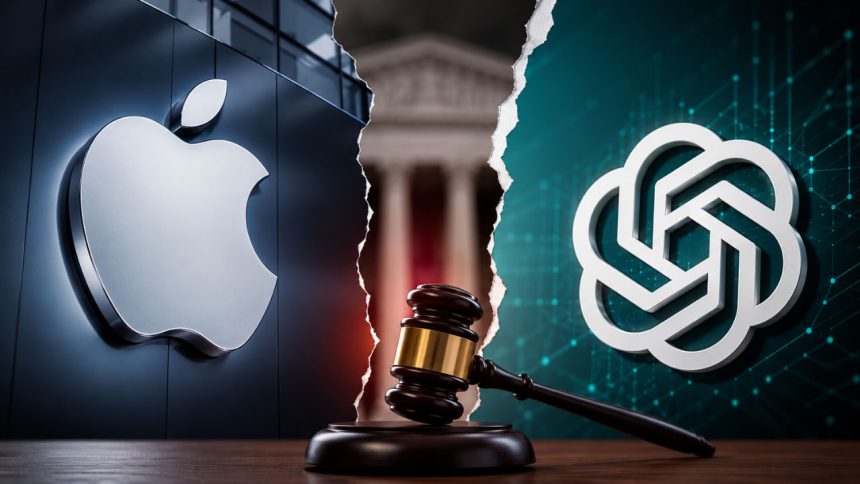
The legal dispute between Apple and OpenAI has entered a crucial new phase after OpenAI asked a U.S. federal court to dismiss Apple’s lawsuit accusing the company of misappropriating trade secrets for the development of future AI hardware.
- OpenAI Seeks Dismissal of Apple’s Trade Secrets Lawsuit
- OpenAI Says Apple’s Complaint Falls Short
- Messages From Former Employee Chang Liu
- iCloud Access After Employment Ends
- Tang Tan Also Plays a Key Role
- OpenAI Questions Apple’s Investigation
- Apple Still Must Prove Trade Secret Misappropriation
- Temporary Injunction Could Affect AI Hardware Plans
- A Long Legal Battle May Lie Ahead
According to OpenAI, Apple’s complaint was filed without sufficient factual investigation and interprets conduct that could reasonably occur during an employee’s departure as evidence of trade secret theft. The company argues that the case should be dismissed before entering years of costly discovery and litigation.
Apple alleges that several former employees—including senior executives who later joined OpenAI—retained or accessed internal company information after leaving Apple and may have used it to support OpenAI’s AI hardware efforts. OpenAI denies those allegations, insisting it neither sought nor used Apple’s confidential information.
OpenAI Says Apple’s Complaint Falls Short
OpenAI’s motion argues that Apple’s complaint fails to identify with sufficient specificity which information qualifies as legally protected trade secrets. It also contends that Apple has not presented credible facts showing that OpenAI or its former employees actually used any confidential information.
The company further distinguishes between an individual still having access to files and actually transferring or exploiting those files for a new employer. According to OpenAI, simply demonstrating that someone could access information does not prove the information was ever misused.
Messages From Former Employee Chang Liu
To support its position, OpenAI released iMessage conversations involving former Apple engineer **Chang Liu**.
Read More

According to OpenAI, the messages show Apple employees continued contacting Liu after his departure, asking him to help locate files, technical documents, and information related to previous projects.
In several conversations, Liu reportedly advised colleagues to continue discussions internally and requested to be removed from group chats once conversations began touching on potentially sensitive company information. OpenAI argues these exchanges demonstrate that Liu was not attempting to transfer confidential information for OpenAI’s benefit.
Apple, however, is expected to argue that responding to questions involving internal information after joining a competing company could still violate confidentiality obligations. Ultimately, the court will have to determine whether the information involved constituted protected trade secrets and whether any unlawful disclosure actually occurred.
iCloud Access After Employment Ends
Another point raised by OpenAI concerns Apple’s offboarding procedures.
OpenAI says some former Apple employees retained access to files or cloud accounts because Apple did not immediately revoke all permissions after their employment ended.
According to OpenAI, some iCloud accounts remained connected to Apple office devices, and Apple employees themselves continued using those accounts to retrieve files needed by ongoing projects.
The company argues that the mere presence of Apple files in a former employee’s account does not automatically indicate an intent to steal confidential information, but may instead reflect incomplete offboarding procedures.
Tang Tan Also Plays a Key Role
Apple’s lawsuit also references **Tang Tan**, the longtime Apple executive who spent more than two decades at the company before joining OpenAI.
Apple alleges Tan retained documents related to Apple’s employee departure procedures and suggests they could have helped other employees avoid internal security checks when moving to OpenAI.
OpenAI rejects that interpretation, saying the documents were used to ensure new hires complied with Apple’s departure requirements and did not bring confidential material into their new workplace.
The dispute may ultimately depend on how the court interprets the purpose for which those documents were retained and used.
OpenAI Questions Apple’s Investigation
OpenAI also disclosed email exchanges between Apple’s outside counsel and OpenAI’s legal team, claiming Apple’s lawyers mistakenly contacted the wrong individual after confusing two people with similar Asian surnames.
While OpenAI argues the incident raises questions about the thoroughness of Apple’s pre-filing investigation, the company acknowledges that such an error alone does not determine whether Apple’s trade secret claims have legal merit. The court will ultimately focus on evidence regarding the alleged trade secrets, their disclosure, and any misuse.
Apple Still Must Prove Trade Secret Misappropriation
Under trade secret law, Apple must establish more than the existence of confidential internal documents.
The company must demonstrate that the disputed information has independent economic value because it is not publicly known, that reasonable measures were taken to protect it, and that the information was unlawfully acquired, disclosed, or used.
Simply showing that former employees possessed company files may not be enough unless Apple can connect those materials directly to OpenAI’s product development. Conversely, evidence linking Apple’s confidential documents to OpenAI’s AI hardware work could significantly strengthen Apple’s case.
Temporary Injunction Could Affect AI Hardware Plans
In addition to seeking damages, Apple has asked the court for a preliminary injunction that could restrict the use of disputed information while the case proceeds.
According to 9to5Mac, the court is scheduled to consider that request on **October 1, 2026**.
If granted, the injunction could impose restrictions on personnel, documents, or projects allegedly connected to Apple’s confidential information, potentially delaying aspects of OpenAI’s hardware development. If denied, Apple would still be free to continue pursuing the underlying lawsuit.
A Long Legal Battle May Lie Ahead
The litigation could take years to resolve.
Trade secret disputes often involve extensive discovery, including emails, messages, system access records, technical documents, and testimony from numerous employees. Cases involving unreleased products can become even more complex because courts frequently seal sensitive evidence to protect confidential information.
The outcome may also influence how technology companies manage employee departures, cloud account access, and recruitment from competitors in the increasingly competitive AI industry.
For now, neither Apple nor OpenAI has shown any indication of pursuing a settlement. OpenAI is asking the court to dismiss the lawsuit entirely, while Apple continues seeking preliminary injunctive relief. The court must first decide whether Apple’s complaint states a legally sufficient claim before the case can proceed to full discovery, making the upcoming rulings particularly significant for both companies and the broader AI hardware industry.