





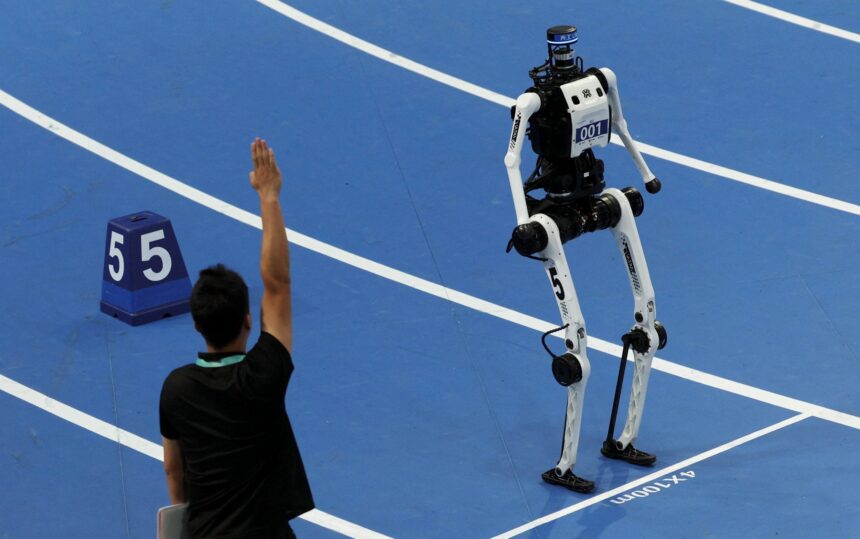
China’s Tiangong Ultra humanoid robot has run 400 metres in 38.15 seconds at the second World Humanoid Robot Games in Beijing, a time faster than the 43.03-second men’s human world record set by South Africa’s Wayde van Niekerk at the 2016 Rio Olympics. The result puts a striking number on the rapid improvement in humanoid locomotion, even though a robot race and a sanctioned human athletics record are not directly equivalent competitions.
The performance came during a five-day event designed to test and showcase humanoid machines across sport and practical tasks. Reports from the event initially put Tiangong Ultra’s 400m time at 38.16 seconds before it was revised to 38.15. The machine was developed by the Beijing Humanoid Robot Innovation Center, a government-backed research organization at the center of China’s push to accelerate humanoid robotics.
인간 세계기록보다 4.88초 빠른 400m
Van Niekerk’s 43.03-second mark has stood since August 2016. Tiangong Ultra’s 38.15-second run is 4.88 seconds quicker on the clock. That comparison is visually dramatic, but it should be interpreted carefully: robots do not compete under the biological, equipment and governing rules that define World Athletics records, so the machine’s result does not replace the official human record.
The run nevertheless demonstrates how quickly robotic hardware, motion control, balance, battery delivery and thermal management are advancing. Maintaining high speed around a full lap is a different engineering challenge from a short straight sprint because the robot must sustain power, negotiate the curve and remain stable as heat and battery load build.
베이징 로봇 게임, 공학 시험장으로 진화
The second World Humanoid Robot Games brought roughly 2,000 robots from 666 teams across 16 countries to Beijing, with 51 events spanning athletics, football, boxing, table tennis and scenario-based tasks. More than 40% of the tests require fully autonomous operation, according to reporting on the event. The mix is deliberate: spectacular races attract attention, while factory, restaurant, office and emergency simulations probe whether humanoids can perform useful work.
Tiangong Ultra’s result followed another headline sprint performance at the same games. In the 100 metres, Tiangong Ultra was reported at 9.39 seconds, faster than Usain Bolt’s 9.58-second human world record from 2009. The robots’ difficulty slowing down after the finish, including collisions with padded barriers, also exposed a central limitation: raw speed is only one part of robust mobility.

속도보다 신뢰성과 정교한 조작이 더 중요
For commercial humanoids, the more consequential tests may be less theatrical. Connecting cables, handling packages, manipulating small objects, recovering from errors and working safely around people require perception, dexterity and control that cannot be measured by sprint times alone. The games therefore function as both a public demonstration and a demanding test environment for hardware and embodied AI.
China has made robotics a strategic industrial priority, using research programs, local-government support and a dense manufacturing supply chain to speed development. The rapid year-to-year gains visible at the games suggest that actuators, batteries, control software and mechanical design are improving together. Whether those gains translate into reliable, affordable robots for factories, logistics and consumer settings will depend on endurance, safety, autonomy and the ability to perform repetitive real-world tasks—not just how quickly a machine can cross a finish line.